Transcribed from the 1903 Chapman and doll clothes for 10 year olds under 20 dollarsHall Sketches byBozedition by David Price, email [email protected]
SKETCHES OF YOUNG COUPLES
CONTENTS
| PAGE |
An Urgent Remonstrance, &c. | 447 |
The Young Couple | 451 |
The Formal Couple | 455 |
The Loving Couple | 458 |
The Contradictory Couple | 463 |
The Couple Who Dote Upon Their Children | 466 |
The Cool Couple | 471 |
The Plausible Couple | 474 |
The Nice Little Couple | 478 |
The Egotistical Couple | 481 |
The Couple Who Coddle Themselves | 485 |
The Old Couple | 489 |
Conclusion | 493 |
p. 447AnUrgent Remonstrance, &c.
TO THE GENTLEMEN OF ENGLAND,
(BEING BACHELORS OR WIDOWERS,)
THEREMONSTRANCE OF THEIR FAITHFUL FELLOW-SUBJECT,
Sheweth,—
That Her Most Gracious Majesty,Victoria, by the Grace of God of the United Kingdom of GreatBritain and Ireland Queen, Defender of the Faith, did, on the23rd day of November last past, declare and pronounce to Her MostHonourable Privy Council, Her Majesty’s Most Graciousintention of entering into the bonds of wedlock.
That Her Most Gracious Majesty, inso making known Her Most Gracious intention to Her MostHonourable Privy Council as aforesaid, did use and employ thewords—‘It is my intention to ally myself in marriagewith Prince Albert of Saxe Coburg and Gotha.’
That the present is Bissextile, orLeap Year, in which it is held and considered lawful for any ladyto offer and submit proposals of marriage to any gentleman, andto enforce and insist upon acceptance of the same, under pain ofa certain fine or penalty; to wit, one silk or satin dress of thefirst quality, to be chosen by the lady and paid (or owed) for,by the gentleman.
That these and other the horrorsand dangers with which the said Bissextile, or Leap Year,threatens the gentlemen of England on every occasion of itsperiodical return, have been greatly aggravated and augmented bythe terms of Her Majesty’s said Most Graciouscommunication, which have filled the heads of divers young ladiesin this Realm with certain new ideas destructive to the peace ofmankind, that never entered their imagination before.
That a case has occurred inCamberwell, in which a young lady informed her Papa that‘she intended to ally herself in marriage’ with Mr.Smith of Stepney; and that another, and a very distressing case,has occurred at Tottenham, in which a young lady not only statedher intention of allying herself in marriage with her cousinJohn, but, taking violent possession of her said cousin, actuallymarried him.
That similar outrages are ofconstant occurrence, not only in the capital and itsneighbourhood, but throughout the kingdom, and that unless theexcited female populace be speedily checked and restrained intheir lawless proceedings, most deplorable results must ensuetherefrom; among which may be anticipated a most alarmingincrease in the population of the country, with which no effortsof the agricultural or manufacturing interest can possibly keeppace.
That there is strong reason tosuspect the existence of a most extensive plot, conspiracy, ordesign, secretly contrived by vast numbers of single ladies inthe United Kingdom of Great Britain and Ireland, and nowextending its ramifications in every quarter of the land; theobject and intent of which plainly appears to be the holding andsolemnising of an enormous and unprecedented number of marriages,on the day on which the nuptials of Her said Most GraciousMajesty are performed.
That such plot, conspiracy, ordesign, strongly savours of Popery, as tending to thediscomfiture of the Clergy of the Established Church, byentailing upon them great mental and physical exhaustion; andthat such Popish plots are fomented and encouraged by HerMajesty’s Ministers, which clearly appears—not onlyfrom Her Majesty’s principal Secretary of State for ForeignAffairs traitorously getting married while holding office underthe Crown; but from Mr. O’Connell having been heard todeclare and avow that, if he had a daughter to marry, she shouldbe married on the same day as Her said Most Gracious Majesty.
That such arch plots, conspiracies,and designs, besides being fraught with danger to the EstablishedChurch, and (consequently) to the State, cannot fail to bringruin and bankruptcy upon a large class of Her Majesty’ssubjects; as a great and sudden increase in the number of marriedmen occasioning the comparative desertion (for a time) ofTaverns, Hotels, Billiard-rooms, and Gaming-Houses, will deprivethe Proprietors of their accustomed profits and returns. And in further proof of the depth and baseness of such designs,it may be here observed, that all proprietors of Taverns, Hotels,Billiard-rooms, and Gaming-Houses, are (especially the last)solemnly devoted to the Protestant religion.
For all these reasons, and manyothers of no less gravity and import, an urgent appeal is made tothe gentlemen of England (being bachelors or widowers) to takeimmediate steps for convening a Public meeting; To consider ofthe best and surest means of averting the dangers with which theyare threatened by the recurrence of Bissextile, or Leap Year, andthe additional sensation created among single ladies by the termsof Her Majesty’s Most Gracious Declaration; To takemeasures, without delay, for resisting the said single Ladies,and counteracting their evil designs; And to pray Her Majesty todismiss her present Ministers, and to summon to her Councilsthose distinguished Gentlemen in various Honourable Professionswho, by insulting on all occasions the only Lady in England whocan be insulted with safety, have given a sufficient guarantee toHer Majesty’s Loving Subjects that they, at least, arequalified to make war with women, and are already expert in theuse of those weapons which are common to the lowest and mostabandoned of the sex.
p. 451THEYOUNG COUPLE
There is to be a wedding thismorning at the corner house in the terrace. Thepastry-cook’s people have been there half-a-dozen timesalready; all day yesterday there was a great stir and bustle, andthey were up this morning as soon as it was light. MissEmma Fielding is going to be married to young Mr. Harvey.
Heaven alone can tell in what bright colours this marriage ispainted upon the mind of the little housemaid at number six, whohas hardly slept a wink all night with thinking of it, and nowstands on the unswept door-steps leaning upon her broom, andlooking wistfully towards the enchanted house. Nothingshort of omniscience can divine what visions of the baker, or thegreen-grocer, or the smart and most insinuating butterman, areflitting across her mind—what thoughts of how she woulddress on such an occasion, if she were a lady—of how shewould dress, if she were only a bride—of how cook woulddress, being bridesmaid, conjointly with her sister ‘inplace’ at Fulham, and how the clergyman, deeming them somany ladies, would be quite humbled and respectful. Whatday-dreams of hope and happiness—of life being oneperpetual holiday, with no master and no mistress to grant orwithhold it—of every Sunday being a Sunday out—ofpure freedom as to curls and ringlets, and no obligation to hidefine heads of hair in caps—what pictures of happiness, vastand immense to her, but utterly ridiculous to us, bewilder thebrain of the little housemaid at number six, all called intoexistence by the wedding at the corner!
We smile at such things, and so we should, though perhaps fora better reason than commonly presents itself. It should bepleasant to us to know that there are notions of happiness somoderate and limited, since upon those who entertain them,happiness and lightness of heart are very easily bestowed.
But the little housemaid is awakened from her reverie, forforth from the door of the magical corner house there runstowards her, all fluttering in smart new dress and streamingribands, her friend Jane Adams, who comes all out of breath toredeem a solemn promise of taking her in, under cover of theconfusion, to see the breakfast table spread forth in state,and—sight of sights!—her young mistress ready dressedfor church.
And there, in good truth, when they have stolen up-stairs ontip-toe and edged themselves in at the chamber-door—thereis Miss Emma ‘looking like the sweetest picter,’ in awhite chip bonnet and orange flowers, and all other eleganciesbecoming a bride, (with the make, shape, and quality of everyarticle of which the girl is perfectly familiar in one moment,and never forgets to her dying day)—and there is MissEmma’s mamma in tears, and Miss Emma’s papacomforting her, and saying how that of course she has been longlooking forward to this, and how happy she ought to be—andthere too is Miss Emma’s sister with her arms round herneck, and the other bridesmaid all smiles and tears, quieting thechildren, who would cry more but that they are so finely dressed,and yet sob for fear sister Emma should be taken away—andit is all so affecting, that the two servant-girls cry more thananybody; and Jane Adams, sitting down upon the stairs, when theyhave crept away, declares that her legs tremble so that shedon’t know what to do, and that she will say for Miss Emma,that she never had a hasty word from her, and that she does hopeand pray she may be happy.
But Jane soon comes round again, and then surely there neverwas anything like the breakfast table, glittering with plate andchina, and set out with flowers and sweets, and long-neckedbottles, in the most sumptuous and dazzling manner. In thecentre, too, is the mighty charm, the cake, glistening withfrosted sugar, and garnished beautifully. They agree thatthere ought to be a little Cupid under one of the barley-sugartemples, or at least two hearts and an arrow; but, with thisexception, there is nothing to wish for, and a table could not behandsomer. As they arrive at this conclusion, who shouldcome in but Mr. John! to whom Jane says that its only Anne fromnumber six; and John says heknows, for he’s oftenwinked his eye down the area, which causes Anne to blush and lookconfused. She is going away, indeed; when Mr. John willhave it that she must drink a glass of wine, and he says nevermind it’s being early in the morning, it won’t hurther: so they shut the door and pour out the wine; and Annedrinking lane’s health, and adding, ‘and here’swishing you yours, Mr. John,’ drinks it in a great manysips,—Mr. John all the time making jokes appropriate to theoccasion. At last Mr. John, who has waxed bolder bydegrees, pleads the usage at weddings, and claims the privilegeof a kiss, which he obtains after a great scuffle; and footstepsbeing now heard on the stairs, they disperse suddenly.
By this time a carriage has driven up to convey the bride tochurch, and Anne of number six prolonging the process of‘cleaning her door,’ has the satisfaction ofbeholding the bride and bridesmaids, and the papa and mamma,hurry into the same and drive rapidly off. Nor is this all,for soon other carriages begin to arrive with a posse of companyall beautifully dressed, at whom she could stand and gaze forever; but having something else to do, is compelled to take onelast long look and shut the street-door.
And now the company have gone down to breakfast, and tearshave given place to smiles, for all the corks are out of thelong-necked bottles, and their contents are disappearingrapidly. Miss Emma’s papa is at the top of the table;Miss Emma’s mamma at the bottom; and beside the latter areMiss Emma herself and her husband,—admitted on all hands tobe the handsomest and most interesting young couple everknown. All down both sides of the table, too, are variousyoung ladies, beautiful to see, and various young gentlemen whoseem to think so; and there, in a post of honour, is an unmarriedaunt of Miss Emma’s, reported to possess unheard-of riches,and to have expressed vast testamentary intentions respecting herfavourite niece and new nephew. This lady has been veryliberal and generous already, as the jewels worn by the brideabundantly testify, but that is nothing to what she means to do,or even to what she has done, for she put herself in closecommunication with the dressmaker three months ago, and prepareda wardrobe (with some articles worked by her own hands) fit for aPrincess. People may call her an old maid, and so she maybe, but she is neither cross nor ugly for all that; on thecontrary, she is very cheerful and pleasant-looking, and verykind and tender-hearted: which is no matter of surprise except tothose who yield to popular prejudices without thinking why, andwill never grow wiser and never know better.
Of all the company though, none are more pleasant to behold orbetter pleased with themselves than two young children, who, inhonour of the day, have seats among the guests. Of these,one is a little fellow of six or eight years old, brother to thebride,—and the other a girl of the same age, or somethingyounger, whom he calls ‘his wife.’ The realbride and bridegroom are not more devoted than they: he all loveand attention, and she all blushes and fondness, toying with alittle bouquet which he gave her this morning, and placing thescattered rose-leaves in her bosom with nature’s owncoquettishness. They have dreamt of each other in theirquiet dreams, these children, and their little hearts have beennearly broken when the absent one has been dispraised injest. When will there come in after-life a passion soearnest, generous, and true as theirs; what, even in its gentlestrealities, can have the grace and charm that hover round suchfairy lovers!
By this time the merriment and happiness of the feast havegained their height; certain ominous looks begin to be exchangedbetween the bridesmaids, and somehow it gets whispered about thatthe carriage which is to take the young couple into the countryhas arrived. Such members of the party as are most disposedto prolong its enjoyments, affect to consider this a false alarm,but it turns out too true, being speedily confirmed, first by theretirement of the bride and a select file of intimates who are toprepare her for the journey, and secondly by the withdrawal ofthe ladies generally. To this there ensues a particularlyawkward pause, in which everybody essays to be facetious, andnobody succeeds; at length the bridegroom makes a mysteriousdisappearance in obedience to some equally mysterious signal; andthe table is deserted.
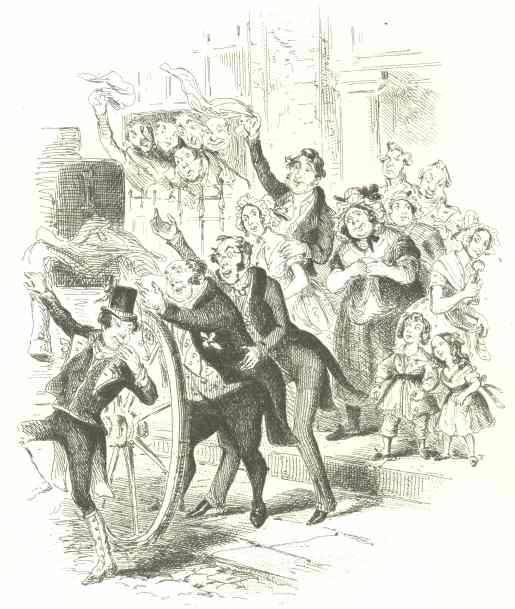
Now, for at least six weeks last past it has been solemnlydevised and settled that the young couple should go away insecret; but they no sooner appear without the door than thedrawing-room windows are blocked up with ladies waving theirhandkerchiefs and kissing their hands, and the dining-room paneswith gentlemen’s faces beaming farewell in every queervariety of its expression. The hall and steps are crowdedwith servants in white favours, mixed up with particular friendsand relations who have darted out to say good-bye; and foremostin the group are the tiny lovers arm in arm, thinking, withfluttering hearts, what happiness it would be to dash awaytogether in that gallant coach, and never part again.
The bride has barely time for one hurried glance at her oldhome, when the steps rattle, the door slams, the horses clatteron the pavement, and they have left it far away.
A knot of women servants still remain clustered in the hall,whispering among themselves, and there of course is Anne fromnumber six, who has made another escape on some plea or other,and been an admiring witness of the departure. There aretwo points on which Anne expatiates over and over again, withoutthe smallest appearance of fatigue or intending to leave off; oneis, that she ‘never see in all her life such a—ohsuch a angel of a gentleman as Mr. Harvey’—and theother, that she ‘can’t tell how it is, but itdon’t seem a bit like a work-a-day, or a Sundayneither—it’s all so unsettled andunregular.’
p. 455THEFORMAL COUPLE
The formal couple are the mostprim, cold, immovable, and unsatisfactory people on the face ofthe earth. Their faces, voices, dress, house, furniture,walk, and manner, are all the essence of formality, unrelieved byone redeeming touch of frankness, heartiness, or nature.
Everything with the formal couple resolves itself into amatter of form. They don’t call upon you on youraccount, but their own; not to see how you are, but to show howthey are: it is not a ceremony to do honour to you, but tothemselves,—not due to your position, but to theirs. If one of a friend’s children die, the formal couple are assure and punctual in sending to the house as the undertaker; if afriend’s family be increased, the monthly nurse is not moreattentive than they. The formal couple, in fact, joyfullyseize all occasions of testifying their good-breeding and preciseobservance of the little usages of society; and for you, who arethe means to this end, they care as much as a man does for thetailor who has enabled him to cut a figure, or a woman for themilliner who has assisted her to a conquest.
Having an extensive connexion among that kind of people whomake acquaintances and eschew friends, the formal gentlemanattends from time to time a great many funerals, to which he isformally invited, and to which he formally goes, as returning acall for the last time. Here his deportment is of the mostfaultless description; he knows the exact pitch of voice it isproper to assume, the sombre look he ought to wear, themelancholy tread which should be his gait for the day. Heis perfectly acquainted with all the dreary courtesies to beobserved in a mourning-coach; knows when to sigh, and when tohide his nose in the white handkerchief; and looks into the graveand shakes his head when the ceremony is concluded, with the sadformality of a mute.
‘What kind of funeral was it?’ says the formallady, when he returns home. ‘Oh!’ replies theformal gentleman, ‘there never was such a gross anddisgusting impropriety; there were no feathers.’ ‘No feathers!’ cries the lady, as if on wings ofblack feathers dead people fly to Heaven, and, lacking them, theymust of necessity go elsewhere. Her husband shakes hishead; and further adds, that they had seed-cake instead ofplum-cake, and that it was all white wine. ‘All whitewine!’ exclaims his wife. ‘Nothing but sherryand madeira,’ says the husband. ‘What! noport?’ ‘Not a drop.’ No port, noplums, and no feathers! ‘You will recollect, mydear,’ says the formal lady, in a voice of stately reproof,‘that when we first met this poor man who is now dead andgone, and he took that very strange course of addressing me atdinner without being previously introduced, I ventured to expressmy opinion that the family were quite ignorant of etiquette, andvery imperfectly acquainted with the decencies of life. Youhave now had a good opportunity of judging for yourself, and allI have to say is, that I trust you will never go to a funeralthereagain.’ ‘My dear,’ repliesthe formal gentleman, ‘I never will.’ So theinformal deceased is cut in his grave; and the formal couple,when they tell the story of the funeral, shake their heads, andwonder what some people’s feelings aremade of, andwhat their notions of propriety canbe!
If the formal couple have a family (which they sometimeshave), they are not children, but little, pale, sour, sharp-nosedmen and women; and so exquisitely brought up, that they might bevery old dwarfs for anything that appeareth to thecontrary. Indeed, they are so acquainted with forms andconventionalities, and conduct themselves with such strictdecorum, that to see the little girl break a looking-glass insome wild outbreak, or the little boy kick his parents, would beto any visitor an unspeakable relief and consolation.
The formal couple are always sticklers for what is rigidlyproper, and have a great readiness in detecting hiddenimpropriety of speech or thought, which by less scrupulous peoplewould be wholly unsuspected. Thus, if they pay a visit tothe theatre, they sit all night in a perfect agony lest anythingimproper or immoral should proceed from the stage; and ifanything should happen to be said which admits of a doubleconstruction, they never fail to take it up directly, and toexpress by their looks the great outrage which their feelingshave sustained. Perhaps this is their chief reason forabsenting themselves almost entirely from places of publicamusement. They go sometimes to the Exhibition of the RoyalAcademy;—but that is often more shocking than the stageitself, and the formal lady thinks that it really is high timeMr. Etty was prosecuted and made a public example of.
We made one at a christening party not long since, where therewere amongst the guests a formal couple, who suffered the acutesttorture from certain jokes, incidental to such an occasion,cut—and very likely dried also—by one of thegodfathers; a red-faced elderly gentleman, who, being highlypopular with the rest of the company, had it all his own way, andwas in great spirits. It was at supper-time that thisgentleman came out in full force. We—being of a graveand quiet demeanour—had been chosen to escort the formallady down-stairs, and, sitting beside her, had a favourableopportunity of observing her emotions.
We have a shrewd suspicion that, in the very beginning, and inthe first blush—literally the first blush—of thematter, the formal lady had not felt quite certain whether thebeing present at such a ceremony, and encouraging, as it were,the public exhibition of a baby, was not an act involving somedegree of indelicacy and impropriety; but certain we are thatwhen that baby’s health was drunk, and allusions were made,by a grey-headed gentleman proposing it, to the time when he haddandled in his arms the young Christian’smother,—certain we are that then the formal lady took thealarm, and recoiled from the old gentleman as from a hoaryprofligate. Still she bore it; she fanned herself with anindignant air, but still she bore it. A comic song wassung, involving a confession from some imaginary gentleman thathe had kissed a female, and yet the formal lady bore it. But when at last, the health of the godfather before-mentionedbeing drunk, the godfather rose to return thanks, and in thecourse of his observations darkly hinted at babies yet unborn,and even contemplated the possibility of the subject of thatfestival having brothers and sisters, the formal lady couldendure no more, but, bowing slightly round, and sweepinghaughtily past the offender, left the room in tears, under theprotection of the formal gentleman.
p. 458THELOVING COUPLE
There cannot be a better practicalillustration of the wise saw and ancient instance, that there maybe too much of a good thing, than is presented by a lovingcouple. Undoubtedly it is meet and proper that two personsjoined together in holy matrimony should be loving, andunquestionably it is pleasant to know and see that they are so;but there is a time for all things, and the couple who happen tobe always in a loving state before company, are well-nighintolerable.
And in taking up this position we would have it distinctlyunderstood that we do not seek alone the sympathy of bachelors,in whose objection to loving couples we recognise interestedmotives and personal considerations. We grant that to thatunfortunate class of society there may be something veryirritating, tantalising, and provoking, in being compelled towitness those gentle endearments and chaste interchanges which toloving couples are quite the ordinary business of life. Butwhile we recognise the natural character of the prejudice towhich these unhappy men are subject, we can neither receive theirbiassed evidence, nor address ourself to their inflamed andangered minds. Dispassionate experience is our only guide;and in these moral essays we seek no less to reform hymenealoffenders than to hold out a timely warning to all risingcouples, and even to those who have not yet set forth upon theirpilgrimage towards the matrimonial market.
Let all couples, present or to come, therefore profit by theexample of Mr. and Mrs. Leaver, themselves a loving couple in thefirst degree.
Mr. and Mrs. Leaver are pronounced by Mrs. Starling, a widowlady who lost her husband when she was young, and lost herselfabout the same-time—for by her own count she has neversince grown five years older—to be a perfect model ofwedded felicity. ‘You would suppose,’ says theromantic lady, ‘that they were lovers only just nowengaged. Never was such happiness! They are sotender, so affectionate, so attached to each other, so enamoured,that positively nothing can be more charming!’
‘Augusta, my soul,’ says Mr. Leaver. ‘Augustus, my life,’ replies Mrs. Leaver. ‘Sing some little ballad, darling,’ quoth Mr.Leaver. ‘I couldn’t, indeed, dearest,’returns Mrs. Leaver. ‘Do, my dove,’ says Mr.Leaver. ‘I couldn’t possibly, my love,’replies Mrs. Leaver; ‘and it’s very naughty of you toask me.’ ‘Naughty, darling!’ cries Mr.Leaver. ‘Yes, very naughty, and very cruel,’returns Mrs. Leaver, ‘for you know I have a sore throat,and that to sing would give me great pain. You’re amonster, and I hate you. Go away!’ Mrs. Leaverhas said ‘go away,’ because Mr. Leaver has tapped herunder the chin: Mr. Leaver not doing as he is bid, but on thecontrary, sitting down beside her, Mrs. Leaver slaps Mr. Leaver;and Mr. Leaver in return slaps Mrs. Leaver, and it being now timefor all persons present to look the other way, they look theother way, and hear a still small sound as of kissing, at whichMrs. Starling is thoroughly enraptured, and whispers herneighbour that if all married couples were like that, what aheaven this earth would be!
The loving couple are at home when this occurs, and maybe onlythree or four friends are present, but, unaccustomed to reserveupon this interesting point, they are pretty much the sameabroad. Indeed upon some occasions, such as a pic-nic or awater-party, their lovingness is even more developed, as we hadan opportunity last summer of observing in person.
There was a great water-party made up to go to Twickenham anddine, and afterwards dance in an empty villa by the river-side,hired expressly for the purpose. Mr. and Mrs. Leaver wereof the company; and it was our fortune to have a seat in the sameboat, which was an eight-oared galley, manned by amateurs, with ablue striped awning of the same pattern as their Guernsey shirts,and a dingy red flag of the same shade as the whiskers of thestroke oar. A coxswain being appointed, and all othermatters adjusted, the eight gentlemen threw themselves intostrong paroxysms, and pulled up with the tide, stimulated by thecompassionate remarks of the ladies, who one and all exclaimed,that it seemed an immense exertion—as indeed it did. At first we raced the other boat, which came alongside in gallantstyle; but this being found an unpleasant amusement, as givingrise to a great quantity of splashing, and rendering the coldpies and other viands very moist, it was unanimously voted down,and we were suffered to shoot a-head, while the second boatfollowed ingloriously in our wake.
It was at this time that we first recognised Mr. Leaver. There were two firemen-watermen in the boat, lying by untilsomebody was exhausted; and one of them, who had taken uponhimself the direction of affairs, was heard to cry in a gruffvoice, ‘Pull away, number two—give it her, numbertwo—take a longer reach, number two—now, number two,sir, think you’re winning a boat.’ The greaterpart of the company had no doubt begun to wonder which of thestriped Guernseys it might be that stood in need of suchencouragement, when a stifled shriek from Mrs. Leaver confirmedthe doubtful and informed the ignorant; and Mr. Leaver, stillfurther disguised in a straw hat and no neckcloth, was observedto be in a fearful perspiration, and failing visibly. Norwas the general consternation diminished at this instant by thesame gentleman (in the performance of an accidental aquatic feat,termed ‘catching a crab’) plunging suddenly backward,and displaying nothing of himself to the company, but twoviolently struggling legs. Mrs. Leaver shrieked againseveral times, and cried piteously—‘Is he dead? Tell me the worst. Is he dead?’
Now, a moment’s reflection might have convinced theloving wife, that unless her husband were endowed with some mostsurprising powers of muscular action, he never could be deadwhile he kicked so hard; but still Mrs. Leaver cried, ‘Ishe dead? is he dead?’ and still everybody elsecried—‘No, no, no,’ until such time as Mr.Leaver was replaced in a sitting posture, and his oar (which hadbeen going through all kinds of wrong-headed performances on itsown account) was once more put in his hand, by the exertions ofthe two firemen-watermen. Mr. Leaver then exclaimed,‘Augustus, my child, come to me;’ and Mr. Leaversaid, ‘Augusta, my love, compose yourself, I am notinjured.’ But Mrs. Leaver cried again more piteouslythan before, ‘Augustus, my child, come to me;’ andnow the company generally, who seemed to be apprehensive that ifMr. Leaver remained where he was, he might contribute more thanhis proper share towards the drowning of the party,disinterestedly took part with Mrs. Leaver, and said he reallyought to go, and that he was not strong enough for such violentexercise, and ought never to have undertaken it. Reluctantly, Mr. Leaver went, and laid himself down at Mrs.Leaver’s feet, and Mrs. Leaver stooping over him, said,‘Oh Augustus, how could you terrify me so?’ and Mr.Leaver said, ‘Augusta, my sweet, I never meant to terrifyyou;’ and Mrs. Leaver said, ‘You are faint, mydear;’ and Mr. Leaver said, ‘I am rather so, mylove;’ and they were very loving indeed under Mrs.Leaver’s veil, until at length Mr. Leaver came forth again,and pleasantly asked if he had not heard something said aboutbottled stout and sandwiches.
Mrs. Starling, who was one of the party, was perfectlydelighted with this scene, and frequently murmured half-aside,‘What a loving couple you are!’ or ‘Howdelightful it is to see man and wife so happytogether!’ To us she was quite poetical, (for we area kind of cousins,) observing that hearts beating in unison likethat made life a paradise of sweets; and that when kindredcreatures were drawn together by sympathies so fine and delicate,what more than mortal happiness did not our souls partake! To all this we answered ‘Certainly,’ or ‘Verytrue,’ or merely sighed, as the case might be. Atevery new act of the loving couple, the widow’s admirationbroke out afresh; and when Mrs. Leaver would not permit Mr.Leaver to keep his hat off, lest the sun should strike to hishead, and give him a brain fever, Mrs. Starling actually shedtears, and said it reminded her of Adam and Eve.
The loving couple were thus loving all the way to Twickenham,but when we arrived there (by which time the amateur crew lookedvery thirsty and vicious) they were more playful than ever, forMrs. Leaver threw stones at Mr. Leaver, and Mr. Leaver ran afterMrs. Leaver on the grass, in a most innocent and enchantingmanner. At dinner, too, Mr. Leaver wouldsteal Mrs.Leaver’s tongue, and Mrs. Leaver wouldretaliateupon Mr. Leaver’s fowl; and when Mrs. Leaver was going totake some lobster salad, Mr. Leaver wouldn’t let her haveany, saying that it made her ill, and she was always sorry for itafterwards, which afforded Mrs. Leaver an opportunity ofpretending to be cross, and showing many otherprettinesses. But this was merely the smiling surface oftheir loves, not the mighty depths of the stream, down to whichthe company, to say the truth, dived rather unexpectedly, fromthe following accident. It chanced that Mr. Leaver tookupon himself to propose the bachelors who had first originatedthe notion of that entertainment, in doing which, he affected toregret that he was no longer of their body himself, and pretendedgrievously to lament his fallen state. This Mrs.Leaver’s feelings could not brook, even in jest, andconsequently, exclaiming aloud, ‘He loves me not, he lovesme not!’ she fell in a very pitiable state into the arms ofMrs. Starling, and, directly becoming insensible, was conveyed bythat lady and her husband into another room. Presently Mr.Leaver came running back to know if there was a medical gentlemanin company, and as there was, (in what company is there not?)both Mr. Leaver and the medical gentleman hurried awaytogether.
The medical gentleman was the first who returned, and amonghis intimate friends he was observed to laugh and wink, and lookas unmedical as might be; but when Mr. Leaver came back he wasvery solemn, and in answer to all inquiries, shook his head, andremarked that Augusta was far too sensitive to be trifledwith—an opinion which the widow subsequentlyconfirmed. Finding that she was in no imminent peril,however, the rest of the party betook themselves to dancing onthe green, and very merry and happy they were, and a vastquantity of flirtation there was; the last circumstance being nodoubt attributable, partly to the fineness of the weather, andpartly to the locality, which is well known to be favourable toall harmless recreations.
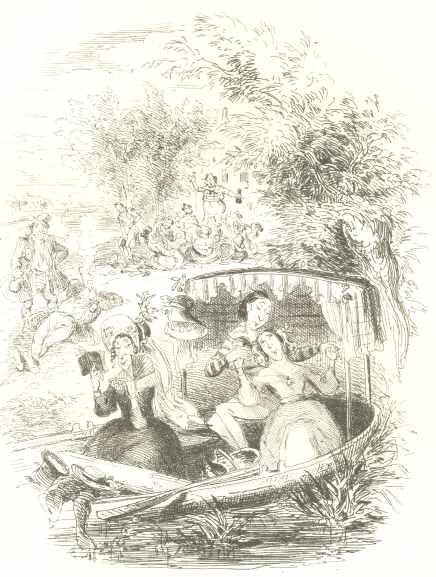
In the bustle of the scene, Mr. and Mrs. Leaver stole down tothe boat, and disposed themselves under the awning, Mrs. Leaverreclining her head upon Mr. Leaver’s shoulder, and Mr.Leaver grasping her hand with great fervour, and looking in herface from time to time with a melancholy and sympatheticaspect. The widow sat apart, feigning to be occupied with abook, but stealthily observing them from behind her fan; and thetwo firemen-watermen, smoking their pipes on the bank hard by,nudged each other, and grinned in enjoyment of the joke. Very few of the party missed the loving couple; and the few whodid, heartily congratulated each other on theirdisappearance.
p. 463THECONTRADICTORY COUPLE
One would suppose that two peoplewho are to pass their whole lives together, and must necessarilybe very often alone with each other, could find little pleasurein mutual contradiction; and yet what is more common than acontradictory couple?
The contradictory couple agree in nothing butcontradiction. They return home from Mrs.Bluebottle’s dinner-party, each in an opposite corner ofthe coach, and do not exchange a syllable until they have beenseated for at least twenty minutes by the fireside at home, whenthe gentleman, raising his eyes from the stove, all at oncebreaks silence:
‘What a very extraordinary thing it is,’ says he,‘that you willcontradict, Charlotte!’ ‘Icontradict!’ cries the lady, ‘butthat’s just like you.’ ‘What’s likeme?’ says the gentleman sharply. ‘Saying that Icontradict you,’ replies the lady. ‘Do you meanto say that you do notcontradict me?’ retorts thegentleman; ‘do you mean to say that you have not beencontradicting me the whole of this day?’ ‘Doyou mean to tell me now, that you have not? I mean to tellyou nothing of the kind,’ replies the lady quietly;‘when you are wrong, of course I shall contradictyou.’
During this dialogue the gentleman has been taking hisbrandy-and-water on one side of the fire, and the lady, with herdressing-case on the table, has been curling her hair on theother. She now lets down her back hair, and proceeds tobrush it; preserving at the same time an air of consciousrectitude and suffering virtue, which is intended to exasperatethe gentleman—and does so.
‘I do believe,’ he says, taking the spoon out ofhis glass, and tossing it on the table, ‘that of all theobstinate, positive, wrong-headed creatures that were ever born,you are the most so, Charlotte.’ ‘Certainly,certainly, have it your own way, pray. You see how muchIcontradict you,’ rejoins the lady. ‘Ofcourse, you didn’t contradict me at dinner-time—ohno, not you!’ says the gentleman. ‘Yes, Idid,’ says the lady. ‘Oh, you did,’ criesthe gentleman ‘you admit that?’ ‘If youcall that contradiction, I do,’ the lady answers;‘and I say again, Edward, that when I know you are wrong, Iwill contradict you. I am not your slave.’ ‘Not my slave!’ repeats the gentleman bitterly;‘and you still mean to say that in the Blackburns’new house there are not more than fourteen doors, including thedoor of the wine-cellar!’ ‘I mean tosay,’ retorts the lady, beating time with her hair-brush onthe palm of her hand, ‘that in that house there arefourteen doors and no more.’ ‘Wellthen—’ cries the gentleman, rising in despair, andpacing the room with rapid strides. ‘By G-, this isenough to destroy a man’s intellect, and drive himmad!’
By and by the gentleman comes-to a little, and passing hishand gloomily across his forehead, reseats himself in his formerchair. There is a long silence, and this time the ladybegins. ‘I appealed to Mr. Jenkins, who sat next tome on the sofa in the drawing-room during tea—’ ‘Morgan, you mean,’ interrupts the gentleman. ‘I do not mean anything of the kind,’ answers thelady. ‘Now, by all that is aggravating and impossibleto bear,’ cries the gentleman, clenching his hands andlooking upwards in agony, ‘she is going to insist upon itthat Morgan is Jenkins!’ ‘Do you take me for aperfect fool?’ exclaims the lady; ‘do you suppose Idon’t know the one from the other? Do you suppose Idon’t know that the man in the blue coat was Mr.Jenkins?’ ‘Jenkins in a blue coat!’ criesthe gentleman with a groan; ‘Jenkins in a blue coat! a manwho would suffer death rather than wear anything butbrown!’ ‘Do you dare to charge me with tellingan untruth?’ demands the lady, bursting into tears. ‘I charge you, ma’am,’ retorts the gentleman,starting up, ‘with being a monster of contradiction, amonster of aggravation, a—a—a—Jenkins in a bluecoat!—what have I done that I should be doomed to hear suchstatements!’
Expressing himself with great scorn and anguish, the gentlemantakes up his candle and stalks off to bed, where feigning to befast asleep when the lady comes up-stairs drowned in tears,murmuring lamentations over her hard fate and indistinctintentions of consulting her brothers, he undergoes the secrettorture of hearing her exclaim between whiles, ‘I knowthere are only fourteen doors in the house, I know it was Mr.Jenkins, I know he had a blue coat on, and I would say it aspositively as I do now, if they were the last words I had tospeak!’
If the contradictory couple are blessed with children, theyare not the less contradictory on that account. MasterJames and Miss Charlotte present themselves after dinner, andbeing in perfect good humour, and finding their parents in thesame amiable state, augur from these appearances half a glass ofwine a-piece and other extraordinary indulgences. Butunfortunately Master James, growing talkative upon suchprospects, asks his mamma how tall Mrs. Parsons is, and whethershe is not six feet high; to which his mamma replies, ‘Yes,she should think she was, for Mrs. Parsons is a very tall ladyindeed; quite a giantess.’ ‘For Heaven’ssake, Charlotte,’ cries her husband, ‘do not tell thechild such preposterous nonsense. Six feethigh!’ ‘Well,’ replies the lady,‘surely I may be permitted to have an opinion; my opinionis, that she is six feet high—at least sixfeet.’ ‘Now you know, Charlotte,’ retortsthe gentleman sternly, ‘that that is notyouropinion—that you have no such idea—and that you onlysay this for the sake of contradiction.’ ‘Youare exceedingly polite,’ his wife replies; ‘to bewrong about such a paltry question as anybody’s height,would be no great crime; but I say again, that I believe Mrs.Parsons to be six feet—more than six feet; nay, I believeyou know her to be full six feet, and only say she is not,because I say she is.’ This taunt disposes thegentleman to become violent, but he cheeks himself, and iscontent to mutter, in a haughty tone, ‘Six feet—ha!ha! Mrs. Parsons six feet!’ and the lady answers,‘Yes, six feet. I am sure I am glad you are amused,and I’ll say it again—six feet.’ Thus thesubject gradually drops off, and the contradiction begins to beforgotten, when Master James, with some undefined notion ofmaking himself agreeable, and putting things to rights again,unfortunately asks his mamma what the moon’s made of; whichgives her occasion to say that he had better not ask her, for sheis always wrong and never can be right; that he only exposes herto contradiction by asking any question of her; and that he hadbetter ask his papa, who is infallible, and never can bewrong. Papa, smarting under this attack, gives a terriblepull at the bell, and says, that if the conversation is toproceed in this way, the children had better be removed. Removed they are, after a few tears and many struggles; and Pahaving looked at Ma sideways for a minute or two, with a balefuleye, draws his pocket-handkerchief over his face, and composeshimself for his after-dinner nap.
The friends of the contradictory couple often deplore theirfrequent disputes, though they rather make light of them at thesame time: observing, that there is no doubt they are very muchattached to each other, and that they never quarrel except abouttrifles. But neither the friends of the contradictorycouple, nor the contradictory couple themselves, reflect, that asthe most stupendous objects in nature are but vast collections ofminute particles, so the slightest and least considered triflesmake up the sum of human happiness or misery.
p. 466THECOUPLE WHO DOTE UPON THEIR CHILDREN
The couple who dote upon theirchildren have usually a great many of them: six or eight atleast. The children are either the healthiest in all theworld, or the most unfortunate in existence. In eithercase, they are equally the theme of their doting parents, andequally a source of mental anguish and irritation to their dotingparents’ friends.
The couple who dote upon their children recognise no dates butthose connected with their births, accidents, illnesses, orremarkable deeds. They keep a mental almanack with a vastnumber of Innocents’-days, all in red letters. Theyrecollect the last coronation, because on that day little Tomfell down the kitchen stairs; the anniversary of the GunpowderPlot, because it was on the fifth of November that Ned askedwhether wooden legs were made in heaven and cocked hats grew ingardens. Mrs. Whiffler will never cease to recollect thelast day of the old year as long as she lives, for it was on thatday that the baby had the four red spots on its nose which theytook for measles: nor Christmas-day, for twenty-one days afterChristmas-day the twins were born; nor Good Friday, for it was ona Good Friday that she was frightened by the donkey-cart when shewas in the family way with Georgiana. The movable feastshave no motion for Mr. and Mrs. Whiffler, but remain pinned downtight and fast to the shoulders of some small child, from whomthey can never be separated any more. Time was made,according to their creed, not for slaves but for girls and boys;the restless sands in his glass are but little children atplay.
As we have already intimated, the children of this couple canknow no medium. They are either prodigies of good health orprodigies of bad health; whatever they are, they must beprodigies. Mr. Whiffler must have to describe at his officesuch excruciating agonies constantly undergone by his eldest boy,as nobody else’s eldest boy ever underwent; or he must beable to declare that there never was a child endowed with suchamazing health, such an indomitable constitution, and such acast-iron frame, as his child. His children must be, insome respect or other, above and beyond the children of all otherpeople. To such an extent is this feeling pushed, that wewere once slightly acquainted with a lady and gentleman whocarried their heads so high and became so proud after theiryoungest child fell out of a two-pair-of-stairs window withouthurting himself much, that the greater part of their friends wereobliged to forego their acquaintance. But perhaps this maybe an extreme case, and one not justly entitled to be consideredas a precedent of general application.
If a friend happen to dine in a friendly way with one of thesecouples who dote upon their children, it is nearly impossible forhim to divert the conversation from their favourite topic. Everything reminds Mr. Whiffler of Ned, or Mrs. Whiffler of MaryAnne, or of the time before Ned was born, or the time before MaryAnne was thought of. The slightest remark, however harmlessin itself, will awaken slumbering recollections of thetwins. It is impossible to steer clear of them. Theywill come uppermost, let the poor man do what he may. Nedhas been known to be lost sight of for half an hour, Dick hasbeen forgotten, the name of Mary Anne has not been mentioned, butthe twins will out. Nothing can keep down the twins.
‘It’s a very extraordinary thing, Saunders,’says Mr. Whiffler to the visitor, ‘but—you have seenour little babies, the—the—twins?’ Thefriend’s heart sinks within him as he answers, ‘Oh,yes—often.’ ‘Your talking of thePyramids,’ says Mr. Whiffler, quite as a matter of course,‘reminds me of the twins. It’s a veryextraordinary thing about those babies—what colour shouldyou say their eyes were?’ ‘Upon my word,’the friend stammers, ‘I hardly know how toanswer’—the fact being, that except as the frienddoes not remember to have heard of any departure from theordinary course of nature in the instance of these twins, theymight have no eyes at all for aught he has observed to thecontrary. ‘You wouldn’t say they were red, Isuppose?’ says Mr. Whiffler. The friend hesitates,and rather thinks they are; but inferring from the expression ofMr. Whiffler’s face that red is not the colour, smiles withsome confidence, and says, ‘No, no! very different fromthat.’ ‘What should you say to blue?’says Mr. Whiffler. The friend glances at him, and observinga different expression in his face, ventures to say, ‘Ishould say they wereblue—a decidedblue.’ ‘To be sure!’ cries Mr. Whiffler,triumphantly, ‘I knew you would! But what should yousay if I was to tell you that the boy’s eyes are blue andthe girl’s hazel, eh?’ ‘Impossible!’ exclaims the friend, not at all knowingwhy it should be impossible. ‘A fact,notwithstanding,’ cries Mr. Whiffler; ‘and let metell you, Saunders, that’snot a common thing intwins, or a circumstance that’ll happen everyday.’
In this dialogue Mrs. Whiffler, as being deeply responsiblefor the twins, their charms and singularities, has taken noshare; but she now relates, in broken English, a witticism oflittle Dick’s bearing upon the subject just discussed,which delights Mr. Whiffler beyond measure, and causes him todeclare that he would have sworn that was Dick’s if he hadheard it anywhere. Then he requests that Mrs. Whiffler willtell Saunders what Tom said about mad bulls; and Mrs. Whifflerrelating the anecdote, a discussion ensues upon the differentcharacter of Tom’s wit and Dick’s wit, from which itappears that Dick’s humour is of a lively turn, whileTom’s style is the dry and caustic. This discussionbeing enlivened by various illustrations, lasts a long time, andis only stopped by Mrs. Whiffler instructing the footman to ringthe nursery bell, as the children were promised that they shouldcome down and taste the pudding.
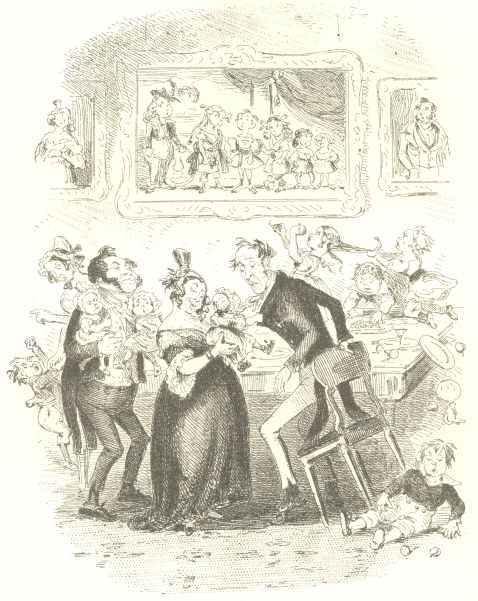
The friend turns pale when this order is given, and palerstill when it is followed up by a great pattering on thestaircase, (not unlike the sound of rain upon a skylight,) aviolent bursting open of the dining-room door, and the tumultuousappearance of six small children, closely succeeded by a strongnursery-maid with a twin in each arm. As the whole eightare screaming, shouting, or kicking—some influenced by aravenous appetite, some by a horror of the stranger, and some bya conflict of the two feelings—a pretty long space elapsesbefore all their heads can be ranged round the table and anythinglike order restored; in bringing about which happy state ofthings both the nurse and footman are severely scratched. At length Mrs. Whiffler is heard to say, ‘Mr. Saunders,shall I give you some pudding?’ A breathless silenceensues, and sixteen small eyes are fixed upon the guest inexpectation of his reply. A wild shout of joy proclaimsthat he has said ‘No, thank you.’ Spoons arewaved in the air, legs appear above the table-cloth inuncontrollable ecstasy, and eighty short fingers dabble in damsonsyrup.
While the pudding is being disposed of, Mr. and Mrs. Whifflerlook on with beaming countenances, and Mr. Whiffler nudging hisfriend Saunders, begs him to take notice of Tom’s eyes, orDick’s chin, or Ned’s nose, or Mary Anne’shair, or Emily’s figure, or little Bob’s calves, orFanny’s mouth, or Carry’s head, as the case maybe. Whatever the attention of Mr. Saunders is called to,Mr. Saunders admires of course; though he is rather confusedabout the sex of the youngest branches and looks at the wrongchildren, turning to a girl when Mr. Whiffler directs hisattention to a boy, and falling into raptures with a boy when heought to be enchanted with a girl. Then the dessert comes,and there is a vast deal of scrambling after fruit, and suddenspirting forth of juice out of tight oranges into infant eyes,and much screeching and wailing in consequence. At lengthit becomes time for Mrs. Whiffler to retire, and all the childrenare by force of arms compelled to kiss and love Mr. Saundersbefore going up-stairs, except Tom, who, lying on his back in thehall, proclaims that Mr. Saunders ‘is a naughtybeast;’ and Dick, who having drunk his father’s winewhen he was looking another way, is found to be intoxicated andis carried out, very limp and helpless.
Mr. Whiffler and his friend are left alone together, but Mr.Whiffler’s thoughts are still with his family, if hisfamily are not with him. ‘Saunders,’ says he,after a short silence, ‘if you please, we’ll drinkMrs. Whiffler and the children.’ Mr. Saunders feelsthis to be a reproach against himself for not proposing the samesentiment, and drinks it in some confusion. ‘Ah!’ Mr. Whiffler sighs, ‘these children,Saunders, make one quite an old man.’ Mr. Saundersthinks that if they were his, they would make him a very old man;but he says nothing. ‘And yet,’ pursues Mr.Whiffler, ‘what can equal domestic happiness? what canequal the engaging ways of children! Saunders, whydon’t you get married?’ Now, this is anembarrassing question, because Mr. Saunders has been thinkingthat if he had at any time entertained matrimonial designs, therevelation of that day would surely have routed them forever. ‘I am glad, however,’ says Mr. Whiffler,‘that you area bachelor,—glad on one account,Saunders; a selfish one, I admit. Will you do Mrs. Whifflerand myself a favour?’ Mr. Saunders issurprised—evidently surprised; but he replies, ‘withthe greatest pleasure.’ ‘Then, will you,Saunders,’ says Mr. Whiffler, in an impressive manner,‘will you cement and consolidate our friendship by cominginto the family (so to speak) as a godfather?’ ‘I shall be proud and delighted,’ replies Mr.Saunders: ‘which of the children is it? really, I thoughtthey were all christened; or—’ ‘Saunders,’ Mr. Whiffler interposes, ‘theyareall christened; you are right. The fact is, thatMrs. Whiffler is—in short, we expect another.’ ‘Not a ninth!’ cries the friend, all aghast at theidea. ‘Yes, Saunders,’ rejoins Mr. Whiffler,solemnly, ‘a ninth. Did we drink Mrs.Whiffler’s health? Let us drink it again, Saunders,and wish her well over it!’
Doctor Johnson used to tell a story of a man who had but oneidea, which was a wrong one. The couple who dote upon theirchildren are in the same predicament: at home or abroad, at alltimes, and in all places, their thoughts are bound up in this onesubject, and have no sphere beyond. They relate the cleverthings their offspring say or do, and weary every company withtheir prolixity and absurdity. Mr. Whiffler takes a friendby the button at a street corner on a windy day to tell him abon motof his youngest boy’s; and Mrs. Whiffler,calling to see a sick acquaintance, entertains her with acheerful account of all her own past sufferings and presentexpectations. In such cases the sins of the fathers indeeddescend upon the children; for people soon come to regard them aspredestined little bores. The couple who dote upon theirchildren cannot be said to be actuated by a general love forthese engaging little people (which would be a great excuse); forthey are apt to underrate and entertain a jealousy of anychildren but their own. If they examined their own hearts,they would, perhaps, find at the bottom of all this, moreself-love and egotism than they think of. Self-love andegotism are bad qualities, of which the unrestrained exhibition,though it may be sometimes amusing, never fails to be wearisomeand unpleasant. Couples who dote upon their children,therefore, are best avoided.
p. 471THECOOL COUPLE
There is an old-fashionedweather-glass representing a house with two doorways, in one ofwhich is the figure of a gentleman, in the other the figure of alady. When the weather is to be fine the lady comes out andthe gentleman goes in; when wet, the gentleman comes out and thelady goes in. They never seek each other’s society,are never elevated and depressed by the same cause, and havenothing in common. They are the model of a cool couple,except that there is something of politeness and considerationabout the behaviour of the gentleman in the weather-glass, inwhich, neither of the cool couple can be said to participate.
The cool couple are seldom alone together, and when they are,nothing can exceed their apathy and dulness: the gentleman beingfor the most part drowsy, and the lady silent. If theyenter into conversation, it is usually of an ironical orrecriminatory nature. Thus, when the gentleman has indulgedin a very long yawn and settled himself more snugly in hiseasy-chair, the lady will perhaps remark, ‘Well, I am sure,Charles! I hope you’re comfortable.’ Towhich the gentleman replies, ‘Oh yes, he’s quitecomfortable quite.’ ‘There are not many marriedmen, I hope,’ returns the lady, ‘who seek comfort insuch selfish gratifications as you do.’ ‘Normany wives who seek comfort in such selfish gratifications asyoudo, I hope,’ retorts the gentleman. ‘Whose fault is that?’ demands the lady. Thegentleman becoming more sleepy, returns no answer. ‘Whose fault is that?’ the lady repeats. Thegentleman still returning no answer, she goes on to say that shebelieves there never was in all this world anybody so attached toher home, so thoroughly domestic, so unwilling to seek amoment’s gratification or pleasure beyond her own firesideas she. God knows that before she was married she neverthought or dreamt of such a thing; and she remembers that herpoor papa used to say again and again, almost every day of hislife, ‘Oh, my dear Louisa, if you only marry a man whounderstands you, and takes the trouble to consider your happinessand accommodate himself a very little to your disposition, what atreasure he will find in you!’ She supposes her papaknew what her disposition was—he had known her longenough—he ought to have been acquainted with it, but whatcan she do? If her home is always dull and lonely, and herhusband is always absent and finds no pleasure in her society,she is naturally sometimes driven (seldom enough, she is sure) toseek a little recreation elsewhere; she is not expected to pineand mope to death, she hopes. ‘Then come,Louisa,’ says the gentleman, waking up as suddenly as hefell asleep, ‘stop at home this evening, and so willI.’ ‘I should be sorry to suppose, Charles,that you took a pleasure in aggravating me,’ replies thelady; ‘but you know as well as I do that I am particularlyengaged to Mrs. Mortimer, and that it would be an act of thegrossest rudeness and ill-breeding, after accepting a seat in herbox and preventing her from inviting anybody else, not togo.’ ‘Ah! there it is!’ says thegentleman, shrugging his shoulders, ‘I knew that perfectlywell. I knew you couldn’t devote an evening to yourown home. Now all I have to say, Louisa, isthis—recollect that Iwas quite willing to stay athome, and that it’s no fault of minewe are notoftener together.’
With that the gentleman goes away to keep an old appointmentat his club, and the lady hurries off to dress for Mrs.Mortimer’s; and neither thinks of the other until by someodd chance they find themselves alone again.
But it must not be supposed that the cool couple arehabitually a quarrelsome one. Quite the contrary. These differences are only occasions for a littleself-excuse,—nothing more. In general they are aseasy and careless, and dispute as seldom, as any commonacquaintances may; for it is neither worth their while to puteach other out of the way, nor to ruffle themselves.
When they meet in society, the cool couple are the best-bredpeople in existence. The lady is seated in a corner among alittle knot of lady friends, one of whom exclaims, ‘Why, Ivow and declare there is your husband, my dear!’ ‘Whose?—mine?’ she says, carelessly. ‘Ay, yours, and coming this way too.’ ‘How very odd!’ says the lady, in a languid tone,‘I thought he had been at Dover.’ The gentlemancoming up, and speaking to all the other ladies and noddingslightly to his wife, it turns out that he has been at Dover, andhas just now returned. ‘What a strange creature youare!’ cries his wife; ‘and what on earth brought youhere, I wonder?’ ‘I came to look after you,of course,’ rejoins her husband. This is sopleasant a jest that the lady is mightily amused, as are all theother ladies similarly situated who are within hearing; and whilethey are enjoying it to the full, the gentleman nods again, turnsupon his heel, and saunters away.
There are times, however, when his company is not soagreeable, though equally unexpected; such as when the lady hasinvited one or two particular friends to tea and scandal, and hehappens to come home in the very midst of their diversion. It is a hundred chances to one that he remains in the house halfan hour, but the lady is rather disturbed by the intrusion,notwithstanding, and reasons within herself,—‘I amsure I never interfere with him, and why should he interfere withme? It can scarcely be accidental; it never happens that Ihave a particular reason for not wishing him to come home, but healways comes. It’s very provoking and tiresome; and Iam sure when he leaves me so much alone for his own pleasure, theleast he could do would be to do as much for mine.’ Observing what passes in her mind, the gentleman, who has comehome for his own accommodation, makes a merit of it with himself;arrives at the conclusion that it is the very last place in whichhe can hope to be comfortable; and determines, as he takes up hishat and cane, never to be so virtuous again.
Thus a great many cool couples go on until they are coldcouples, and the grave has closed over their folly andindifference. Loss of name, station, character, lifeitself, has ensued from causes as slight as these, before now;and when gossips tell such tales, and aggravate theirdeformities, they elevate their hands and eyebrows, and call eachother to witness what a cool couple Mr. and Mrs. So-and-so alwayswere, even in the best of times.
p. 474THEPLAUSIBLE COUPLE
The plausible couple have manytitles. They are ‘a delightful couple,’ an‘affectionate couple,’ ‘a most agreeablecouple, ‘a good-hearted couple,’ and ‘thebest-natured couple in existence.’ The truth is, thatthe plausible couple are people of the world; and either the wayof pleasing the world has grown much easier than it was in thedays of the old man and his ass, or the old man was but a badhand at it, and knew very little of the trade.
‘But is it really possible to please the world!’says some doubting reader. It is indeed. Nay, it isnot only very possible, but very easy. The ways arecrooked, and sometimes foul and low. What then? A manneed but crawl upon his hands and knees, know when to close hiseyes and when his ears, when to stoop and when to stand upright;and if by the world is meant that atom of it in which he moveshimself, he shall please it, never fear.
Now, it will be readily seen, that if a plausible man or womanhave an easy means of pleasing the world by an adaptation of selfto all its twistings and twinings, a plausible man andwoman, or, in other words, a plausible couple, playing into eachother’s hands, and acting in concert, have a manifestadvantage. Hence it is that plausible couples scarcely everfail of success on a pretty large scale; and hence it is that ifthe reader, laying down this unwieldy volume at the next fullstop, will have the goodness to review his or her circle ofacquaintance, and to search particularly for some man and wifewith a large connexion and a good name, not easily referable totheir abilities or their wealth, he or she (that is, the male orfemale reader) will certainly find that gentleman or lady, on avery short reflection, to be a plausible couple.
The plausible couple are the most ecstatic people living: themost sensitive people—to merit—on the face of theearth. Nothing clever or virtuous escapes them. Theyhave microscopic eyes for such endowments, and can find themanywhere. The plausible couple never fawn—ohno! They don’t even scruple to tell their friends oftheir faults. One is too generous, another too candid; athird has a tendency to think all people like himself, and toregard mankind as a company of angels; a fourth is kind-heartedto a fault. ‘We never flatter, my dear Mrs.Jackson,’ say the plausible couple; ‘we speak ourminds. Neither you nor Mr. Jackson have faultsenough. It may sound strangely, but it is true. Youhave not faults enough. You know our way,—we mustspeak out, and always do. Quarrel with us for saying so, ifyou will; but we repeat it,—you have not faultsenough!’
The plausible couple are no less plausible to each other thanto third parties. They are always loving andharmonious. The plausible gentleman calls his wife‘darling,’ and the plausible lady addresses him as‘dearest.’ If it be Mr. and Mrs. BobtailWidger, Mrs. Widger is ‘Lavinia, darling,’ and Mr.Widger is ‘Bobtail, dearest.’ Speaking of eachother, they observe the same tender form. Mrs. Widgerrelates what ‘Bobtail’ said, and Mr. Widger recountswhat ‘darling’ thought and did.
If you sit next to the plausible lady at a dinner-table, shetakes the earliest opportunity of expressing her belief that youare acquainted with the Clickits; she is sure she has heard theClickits speak of you—she must not tell you in what terms,or you will take her for a flatterer. You admit a knowledgeof the Clickits; the plausible lady immediately launches out intheir praise. She quite loves the Clickits. Werethere ever such true-hearted, hospitable, excellentpeople—such a gentle, interesting little woman as Mrs.Clickit, or such a frank, unaffected creature as Mr. Clickit?were there ever two people, in short, so little spoiled by theworld as they are? ‘As who, darling?’ cries Mr.Widger, from the opposite side of the table. ‘TheClickits, dearest,’ replies Mrs. Widger. ‘Indeed you are right, darling,’ Mr. Widger rejoins;‘the Clickits are a very high-minded, worthy, estimablecouple.’ Mrs. Widger remarking that Bobtail alwaysgrows quite eloquent upon this subject, Mr. Widger admits that hefeels very strongly whenever such people as the Clickits and someother friends of his (here he glances at the host and hostess)are mentioned; for they are an honour to human nature, and do onegood to think of. ‘Youknow the Clickits, Mrs.Jackson?’ he says, addressing the lady of the house. ‘No, indeed; we have not that pleasure,’ shereplies. ‘You astonish me!’ exclaims Mr.Widger: ‘not know the Clickits! why, you are the verypeople of all others who ought to be their bosom friends. You are kindred beings; you are one and the same thing:—notknow the Clickits! Now willyou know theClickits? Will you make a point of knowing them? Willyou meet them in a friendly way at our house one evening, and beacquainted with them?’ Mrs. Jackson will be quitedelighted; nothing would give her more pleasure. ‘Then, Lavinia, my darling,’ says Mr. Widger,‘mind you don’t lose sight of that; now, pray takecare that Mr. and Mrs. Jackson know the Clickits without loss oftime. Such people ought not to be strangers to eachother.’ Mrs. Widger books both families as the centreof attraction for her next party; and Mr. Widger, going on toexpatiate upon the virtues of the Clickits, adds to their othermoral qualities, that they keep one of the neatest phaetons intown, and have two thousand a year.
As the plausible couple never laud the merits of any absentperson, without dexterously contriving that their praises shallreflect upon somebody who is present, so they never depreciateanything or anybody, without turning their depreciation to thesame account. Their friend, Mr. Slummery, say they, isunquestionably a clever painter, and would no doubt be verypopular, and sell his pictures at a very high price, if thatcruel Mr. Fithers had not forestalled him in his department ofart, and made it thoroughly and completely hisown;—Fithers, it is to be observed, being present andwithin hearing, and Slummery elsewhere. Is Mrs. Tabblewickreally as beautiful as people say? Why, there indeed youask them a very puzzling question, because there is no doubt thatshe is a very charming woman, and they have long known herintimately. She is no doubt beautiful, very beautiful; theyonce thought her the most beautiful woman ever seen; still if youpress them for an honest answer, they are bound to say that thiswas before they had ever seen our lovely friend on the sofa, (thesofa is hard by, and our lovely friend can’t help hearingthe whispers in which this is said;) since that time, perhaps,they have been hardly fair judges; Mrs. Tabblewick is no doubtextremely handsome,—very like our friend, in fact, in theform of the features,—but in point of expression, and soul,and figure, and air altogether—oh dear!
But while the plausible couple depreciate, they are stillcareful to preserve their character for amiability and kindfeeling; indeed the depreciation itself is often made to grow outof their excessive sympathy and good will. The plausiblelady calls on a lady who dotes upon her children, and is sittingwith a little girl upon her knee, enraptured by her artlessreplies, and protesting that there is nothing she delights in somuch as conversing with these fairies; when the other ladyinquires if she has seen young Mrs. Finching lately, and whetherthe baby has turned out a finer one than it promised to be. ‘Oh dear!’ cries the plausible lady, ‘youcannot think how often Bobtail and I have talked about poor Mrs.Finching—she is such a dear soul, and was so anxious thatthe baby should be a fine child—and very naturally, becauseshe was very much here at one time, and there is, you know, anatural emulation among mothers—that it is impossible totell you how much we have felt for her.’ ‘Is itweak or plain, or what?’ inquires the other. ‘Weak or plain, my love,’ returns the plausible lady,‘it’s a fright—a perfect little fright; younever saw such a miserable creature in all your days. Positively you must not let her see one of these beautiful dearsagain, or you’ll break her heart, you willindeed.—Heaven bless this child, see how she is looking inmy face! can you conceive anything prettier than that? Ifpoor Mrs. Finching could only hope—but that’simpossible—and the gifts of Providence, you know—WhatdidI do with my pocket-handkerchief!’
What prompts the mother, who dotes upon her children, tocomment to her lord that evening on the plausible lady’sengaging qualities and feeling heart, and what is it thatprocures Mr. and Mrs. Bobtail Widger an immediate invitation todinner?
p. 478THENICE LITTLE COUPLE
A custom once prevailed inold-fashioned circles, that when a lady or gentleman was unableto sing a song, he or she should enliven the company with astory. As we find ourself in the predicament of not beingable to describe (to our own satisfaction) nice little couples inthe abstract, we purpose telling in this place a little storyabout a nice little couple of our acquaintance.
Mr. and Mrs. Chirrup are the nice little couple inquestion. Mr. Chirrup has the smartness, and something ofthe brisk, quick manner of a small bird. Mrs. Chirrup isthe prettiest of all little women, and has the prettiest littlefigure conceivable. She has the neatest little foot, andthe softest little voice, and the pleasantest little smile, andthe tidiest little curls, and the brightest little eyes, and thequietest little manner, and is, in short, altogether one of themost engaging of all little women, dead or alive. She is acondensation of all the domestic virtues,—a pocket editionof the young man’s best companion,—a little woman ata very high pressure, with an amazing quantity of goodness andusefulness in an exceedingly small space. Little as she is,Mrs. Chirrup might furnish forth matter for the moral equipmentof a score of housewives, six feet high in theirstockings—if, in the presence of ladies, we may be allowedthe expression—and of corresponding robustness.
Nobody knows all this better than Mr. Chirrup, though herather takes on that he don’t. Accordingly he is veryproud of his better-half, and evidently considers himself, as allother people consider him, rather fortunate in having her towife. We say evidently, because Mr. Chirrup is awarm-hearted little fellow; and if you catch his eye when he hasbeen slyly glancing at Mrs. Chirrup in company, there is acertain complacent twinkle in it, accompanied, perhaps, by ahalf-expressed toss of the head, which as clearly indicates whathas been passing in his mind as if he had put it into words, andshouted it out through a speaking-trumpet. Moreover, Mr.Chirrup has a particularly mild and bird-like manner of callingMrs. Chirrup ‘my dear;’ and—for he is of ajocose turn—of cutting little witticisms upon her, andmaking her the subject of various harmless pleasantries, whichnobody enjoys more thoroughly than Mrs. Chirrup herself. Mr. Chirrup, too, now and then affects to deplore hisbachelor-days, and to bemoan (with a marvellously contented andsmirking face) the loss of his freedom, and the sorrow of hisheart at having been taken captive by Mrs. Chirrup—all ofwhich circumstances combine to show the secret triumph andsatisfaction of Mr. Chirrup’s soul.
We have already had occasion to observe that Mrs. Chirrup isan incomparable housewife. In all the arts of domesticarrangement and management, in all the mysteries ofconfectionery-making, pickling, and preserving, never was such athorough adept as that nice little body. She is, besides, acunning worker in muslin and fine linen, and a special hand atmarketing to the very best advantage. But if there be onebranch of housekeeping in which she excels to an utterlyunparalleled and unprecedented extent, it is in the important oneof carving. A roast goose is universally allowed to be thegreat stumbling-block in the way of young aspirants to perfectionin this department of science; many promising carvers, beginningwith legs of mutton, and preserving a good reputation throughfillets of veal, sirloins of beef, quarters of lamb, fowls, andeven ducks, have sunk before a roast goose, and lost caste andcharacter for ever. To Mrs. Chirrup the resolving a gooseinto its smallest component parts is a pleasant pastime—apractical joke—a thing to be done in a minute or so,without the smallest interruption to the conversation of thetime. No handing the dish over to an unfortunate man uponher right or left, no wild sharpening of the knife, no hackingand sawing at an unruly joint, no noise, no splash, no heat, noleaving off in despair; all is confidence and cheerfulness. The dish is set upon the table, the cover is removed; for aninstant, and only an instant, you observe that Mrs.Chirrup’s attention is distracted; she smiles, but hearethnot. You proceed with your story; meanwhile the glitteringknife is slowly upraised, both Mrs. Chirrup’s wrists areslightly but not ungracefully agitated, she compresses her lipsfor an instant, then breaks into a smile, and all is over. The legs of the bird slide gently down into a pool of gravy, thewings seem to melt from the body, the breast separates into a rowof juicy slices, the smaller and more complicated parts of hisanatomy are perfectly developed, a cavern of stuffing isrevealed, and the goose is gone!
To dine with Mr. and Mrs. Chirrup is one of the pleasantestthings in the world. Mr. Chirrup has a bachelor friend, wholived with him in his own days of single blessedness, and to whomhe is mightily attached. Contrary to the usual custom, thisbachelor friend is no less a friend of Mrs. Chirrup’s, and,consequently, whenever you dine with Mr. and Mrs. Chirrup, youmeet the bachelor friend. It would put anyreasonably-conditioned mortal into good-humour to observe theentire unanimity which subsists between these three; but there isa quiet welcome dimpling in Mrs. Chirrup’s face, a bustlinghospitality oozing as it were out of the waistcoat-pockets of Mr.Chirrup, and a patronising enjoyment of their cordiality andsatisfaction on the part of the bachelor friend, which is quitedelightful. On these occasions Mr. Chirrup usually takes anopportunity of rallying the friend on being single, and thefriend retorts on Mr. Chirrup for being married, at which momentssome single young ladies present are like to die of laughter; andwe have more than once observed them bestow looks upon thefriend, which convinces us that his position is by no means asafe one, as, indeed, we hold no bachelor’s to be whovisits married friends and cracks jokes on wedlock, for certainit is that such men walk among traps and nets and pitfallsinnumerable, and often find themselves down upon their knees atthe altar rails, taking M. or N. for their wedded wives, beforethey know anything about the matter.
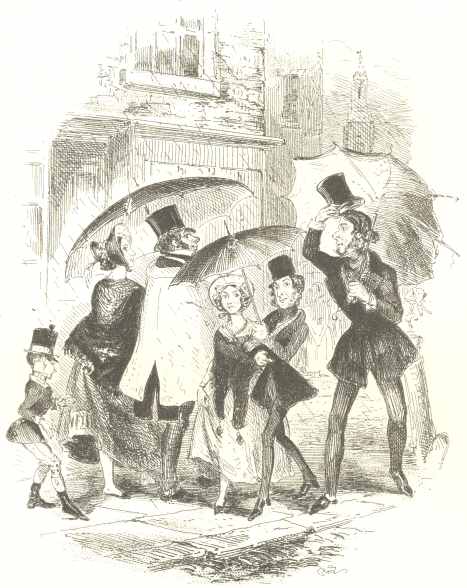
However, this is no business of Mr. Chirrup’s, whotalks, and laughs, and drinks his wine, and laughs again, andtalks more, until it is time to repair to the drawing-room,where, coffee served and over, Mrs. Chirrup prepares for a roundgame, by sorting the nicest possible little fish into the nicestpossible little pools, and calling Mr. Chirrup to assist her,which Mr. Chirrup does. As they stand side by side, youfind that Mr. Chirrup is the least possible shadow of a shadetaller than Mrs. Chirrup, and that they are the neatest andbest-matched little couple that can be, which the chances are tento one against your observing with such effect at any other time,unless you see them in the street arm-in-arm, or meet them somerainy day trotting along under a very small umbrella. Theround game (at which Mr. Chirrup is the merriest of the party)being done and over, in course of time a nice little trayappears, on which is a nice little supper; and when that isfinished likewise, and you have said ‘Good night,’you find yourself repeating a dozen times, as you ride home, thatthere never was such a nice little couple as Mr. and Mrs.Chirrup.
Whether it is that pleasant qualities, being packed moreclosely in small bodies than in large, come more readily to handthan when they are diffused over a wider space, and have to begathered together for use, we don’t know, but as a generalrule,—strengthened like all other rules by itsexceptions,—we hold that little people are sprightly andgood-natured. The more sprightly and good-natured people wehave, the better; therefore, let us wish well to all nice littlecouples, and hope that they may increase and multiply.
p. 481THEEGOTISTICAL COUPLE
Egotism in couples is of twokinds.—It is our purpose to show this by two examples.
The egotistical couple may be young, old, middle-aged, well todo, or ill to do; they may have a small family, a large family,or no family at all. There is no outward sign by which anegotistical couple may be known and avoided. They come uponyou unawares; there is no guarding against them. No man canof himself be forewarned or forearmed against an egotisticalcouple.
The egotistical couple have undergone every calamity, andexperienced every pleasurable and painful sensation of which ournature is susceptible. You cannot by possibility tell theegotistical couple anything they don’t know, or describe tothem anything they have not felt. They have been everythingbut dead. Sometimes we are tempted to wish they had beeneven that, but only in our uncharitable moments, which are fewand far between.
We happened the other day, in the course of a morning call, toencounter an egotistical couple, nor were we suffered to remainlong in ignorance of the fact, for our very first inquiry of thelady of the house brought them into active and vigorousoperation. The inquiry was of course touching thelady’s health, and the answer happened to be, that she hadnot been very well. ‘Oh, my dear!’ said theegotistical lady, ‘don’t talk of not beingwell. We have been in sucha state since we saw youlast!’—The lady of the house happening to remark thather lord had not been well either, the egotistical gentlemanstruck in: ‘Never let Briggs complain of not beingwell—never let Briggs complain, my dear Mrs. Briggs, afterwhat I have undergone within these six weeks. Hedoesn’t know what it is to be ill, he hasn’t theleast idea of it; not the faintestconception.’—‘My dear,’ interposed hiswife smiling, ‘you talk as if it were almost a crime in Mr.Briggs not to have been as ill as we have been, instead offeeling thankful to Providence that both he and our dear Mrs.Briggs are in such blissful ignorance of realsuffering.’—‘My love,’ returned theegotistical gentleman, in a low and pious voice, ‘youmistake me;—I feel grateful—very grateful. Itrust our friends may never purchase their experience as dearlyas we have bought ours; I hope they never may!’
Having put down Mrs. Briggs upon this theme, and settled thequestion thus, the egotistical gentleman turned to us, and, aftera few preliminary remarks, all tending towards and leading up tothe point he had in his mind, inquired if we happened to beacquainted with the Dowager Lady Snorflerer. On ourreplying in the negative, he presumed we had often met LordSlang, or beyond all doubt, that we were on intimate terms withSir Chipkins Glogwog. Finding that we were equally unableto lay claim to either of these distinctions, he expressed greatastonishment, and turning to his wife with a retrospective smile,inquired who it was that had told that capital story about themashed potatoes. ‘Who, my dear?’ returned theegotistical lady, ‘why Sir Chipkins, of course; how can youask! Don’t you remember his applying it to our cook,and saying that you and I were so like the Prince and Princess,that he could almost have sworn we were they?’ ‘To be sure, I remember that,’ said the egotisticalgentleman, ‘but are you quite certain that didn’tapply to the other anecdote about the Emperor of Austria and thepump?’ ‘Upon my word then, I think itdid,’ replied his wife. ‘To be sure itdid,’ said the egotistical gentleman, ‘it wasSlang’s story, I remember now, perfectly.’ However, it turned out, a few seconds afterwards, that theegotistical gentleman’s memory was rather treacherous, ashe began to have a misgiving that the story had been told by theDowager Lady Snorflerer the very last time they dined there; butthere appearing, on further consideration, strong circumstantialevidence tending to show that this couldn’t be, inasmuch asthe Dowager Lady Snorflerer had been, on the occasion inquestion, wholly engrossed by the egotistical lady, theegotistical gentleman recanted this opinion; and after laying thestory at the doors of a great many great people, happily left itat last with the Duke of Scuttlewig:—observing that it wasnot extraordinary he had forgotten his Grace hitherto, as itoften happened that the names of those with whom we were upon themost familiar footing were the very last to present themselves toour thoughts.
It not only appeared that the egotistical couple kneweverybody, but that scarcely any event of importance or notorietyhad occurred for many years with which they had not been in someway or other connected. Thus we learned that when thewell-known attempt upon the life of George the Third was made byHatfield in Drury Lane theatre, the egotistical gentleman’sgrandfather sat upon his right hand and was the first man whocollared him; and that the egotistical lady’s aunt, sittingwithin a few boxes of the royal party, was the only person in theaudience who heard his Majesty exclaim, ‘Charlotte,Charlotte, don’t be frightened, don’t be frightened;they’re letting off squibs, they’re letting offsquibs.’ When the fire broke out, which ended in thedestruction of the two Houses of Parliament, the egotisticalcouple, being at the time at a drawing-room window on Blackheath,then and there simultaneously exclaimed, to the astonishment of awhole party—‘It’s the House ofLords!’ Nor was this a solitary instance of theirpeculiar discernment, for chancing to be (as by a comparison ofdates and circumstances they afterwards found) in the sameomnibus with Mr. Greenacre, when he carried his victim’shead about town in a blue bag, they both remarked a singulartwitching in the muscles of his countenance; and walking downFish Street Hill, a few weeks since, the egotistical gentlemansaid to his lady—slightly casting up his eyes to the top ofthe Monument—‘There’s a boy up there, my dear,reading a Bible. It’s very strange. Idon’t like it.—In five seconds afterwards,Sir,’ says the egotistical gentleman, bringing his handstogether with one violent clap—‘the lad wasover!’
Diversifying these topics by the introduction of many othersof the same kind, and entertaining us between whiles with aminute account of what weather and diet agreed with them, andwhat weather and diet disagreed with them, and at what time theyusually got up, and at what time went to bed, with many otherparticulars of their domestic economy too numerous to mention;the egotistical couple at length took their leave, and affordedus an opportunity of doing the same.
Mr. and Mrs. Sliverstone are an egotistical couple of anotherclass, for all the lady’s egotism is about her husband, andall the gentleman’s about his wife. Forexample:—Mr. Sliverstone is a clerical gentleman, andoccasionally writes sermons, as clerical gentlemen do. Ifyou happen to obtain admission at the street-door while he is soengaged, Mrs. Sliverstone appears on tip-toe, and speaking in asolemn whisper, as if there were at least three or fourparticular friends up-stairs, all upon the point of death,implores you to be very silent, for Mr. Sliverstone is composing,and she need not say how very important it is that he should notbe disturbed. Unwilling to interrupt anything so serious,you hasten to withdraw, with many apologies; but this Mrs.Sliverstone will by no means allow, observing, that she knows youwould like to see him, as it is very natural you should, and thatshe is determined to make a trial for you, as you are a greatfavourite. So you are led up-stairs—still ontip-toe—to the door of a little back room, in which, as thelady informs you in a whisper, Mr. Sliverstone alwayswrites. No answer being returned to a couple of soft taps,the lady opens the door, and there, sure enough, is Mr.Sliverstone, with dishevelled hair, powdering away with pen, ink,and paper, at a rate which, if he has any power of sustaining it,would settle the longest sermon in no time. At first he istoo much absorbed to be roused by this intrusion; but presentlylooking up, says faintly, ‘Ah!’ and pointing to hisdesk with a weary and languid smile, extends his hand, and hopesyou’ll forgive him. Then Mrs. Sliverstone sits downbeside him, and taking his hand in hers, tells you how that Mr.Sliverstone has been shut up there ever since nine o’clockin the morning, (it is by this time twelve at noon,) and how sheknows it cannot be good for his health, and is very uneasy aboutit. Unto this Mr. Sliverstone replies firmly, that‘It must be done;’ which agonizes Mrs. Sliverstonestill more, and she goes on to tell you that such were Mr.Sliverstone’s labours last week—what with theburyings, marryings, churchings, christenings, and alltogether,—that when he was going up the pulpit stairs onSunday evening, he was obliged to hold on by the rails, or hewould certainly have fallen over into his own pew. Mr.Sliverstone, who has been listening and smiling meekly, says,‘Not quite so bad as that, not quite so bad!’ headmits though, on cross-examination, that he wasvery nearfalling upon the verger who was following him up to bolt thedoor; but adds, that it was his duty as a Christian to fall uponhim, if need were, and that he, Mr. Sliverstone, and (possiblythe verger too) ought to glory in it.
This sentiment communicates new impulse to Mrs. Sliverstone,who launches into new praises of Mr. Sliverstone’s worthand excellence, to which he listens in the same meek silence,save when he puts in a word of self-denial relative to somequestion of fact, as—‘Not seventy-two christeningsthat week, my dear. Only seventy-one, onlyseventy-one.’ At length his lady has quite concluded,and then he says, Why should he repine, why should he give way,why should he suffer his heart to sink within him? Is it healone who toils and suffers? What has she gone through, heshould like to know? What does she go through every day forhim and for society?
With such an exordium Mr. Sliverstone launches out intoglowing praises of the conduct of Mrs. Sliverstone in theproduction of eight young children, and the subsequent rearingand fostering of the same; and thus the husband magnifies thewife, and the wife the husband.
This would be well enough if Mr. and Mrs. Sliverstone kept itto themselves, or even to themselves and a friend or two; butthey do not. The more hearers they have, the moreegotistical the couple become, and the more anxious they are tomake believers in their merits. Perhaps this is the worstkind of egotism. It has not even the poor excuse of beingspontaneous, but is the result of a deliberate system and maliceaforethought. Mere empty-headed conceit excites our pity,but ostentatious hypocrisy awakens our disgust.
p. 485THECOUPLE WHO CODDLE THEMSELVES
Mrs. Merrywinkle’s maidenname was Chopper. She was the only child of Mr. and Mrs.Chopper. Her father died when she was, as the play-booksexpress it, ‘yet an infant;’ and so old Mrs. Chopper,when her daughter married, made the house of her son-in-law herhome from that time henceforth, and set up her staff of rest withMr. and Mrs. Merrywinkle.
Mr. and Mrs. Merrywinkle are a couple who coddle themselves;and the venerable Mrs. Chopper is an aider and abettor in thesame.
Mr. Merrywinkle is a rather lean and long-necked gentleman,middle-aged and middle-sized, and usually troubled with a cold inthe head. Mrs. Merrywinkle is a delicate-looking lady, withvery light hair, and is exceedingly subject to the sameunpleasant disorder. The venerable Mrs. Chopper—whois strictly entitled to the appellation, her daughter not beingvery young, otherwise than by courtesy, at the time of hermarriage, which was some years ago—is a mysterious old ladywho lurks behind a pair of spectacles, and is afflicted with achronic disease, respecting which she has taken a vast deal ofmedical advice, and referred to a vast number of medical books,without meeting any definition of symptoms that at all suits her,or enables her to say, ‘That’s mycomplaint.’ Indeed, the absence of authenticinformation upon the subject of this complaint would seem to beMrs. Chopper’s greatest ill, as in all other respects sheis an uncommonly hale and hearty gentlewoman.
Both Mr. and Mrs. Chopper wear an extraordinary quantity offlannel, and have a habit of putting their feet in hot water toan unnatural extent. They likewise indulge in chamomile teaand such-like compounds, and rub themselves on the slightestprovocation with camphorated spirits and other lotions applicableto mumps, sore-throat, rheumatism, or lumbago.
Mr. Merrywinkle’s leaving home to go to business on adamp or wet morning is a very elaborate affair. He puts onwash-leather socks over his stockings, and India-rubber shoesabove his boots, and wears under his waistcoat a cuirass ofhare-skin. Besides these precautions, he winds a thickshawl round his throat, and blocks up his mouth with a large silkhandkerchief. Thus accoutred, and furnished besides with agreat-coat and umbrella, he braves the dangers of the streets;travelling in severe weather at a gentle trot, the better topreserve the circulation, and bringing his mouth to the surfaceto take breath, but very seldom, and with the utmostcaution. His office-door opened, he shoots past his clerkat the same pace, and diving into his own private room, closesthe door, examines the window-fastenings, and gradually unrobeshimself: hanging his pocket-handkerchief on the fender to air,and determining to write to the newspapers about the fog, which,he says, ‘has really got to that pitch that it is quiteunbearable.’
In this last opinion Mrs. Merrywinkle and her respected motherfully concur; for though not present, their thoughts and tonguesare occupied with the same subject, which is their constant themeall day. If anybody happens to call, Mrs. Merrywinkleopines that they must assuredly be mad, and her first salutationis, ‘Why, what in the name of goodness can bring you out insuch weather? You know you mustcatch yourdeath.’ This assurance is corroborated by Mrs.Chopper, who adds, in further confirmation, a dismal legendconcerning an individual of her acquaintance who, making a callunder precisely parallel circumstances, and being then in thebest health and spirits, expired in forty-eight hours afterwards,of a complication of inflammatory disorders. The visitor,rendered not altogether comfortable perhaps by this and otherprecedents, inquires very affectionately after Mr. Merrywinkle,but by so doing brings about no change of the subject; for Mr.Merrywinkle’s name is inseparably connected with hiscomplaints, and his complaints are inseparably connected withMrs. Merrywinkle’s; and when these are done with, Mrs.Chopper, who has been biding her time, cuts in with the chronicdisorder—a subject upon which the amiable old lady neverleaves off speaking until she is left alone, and very often notthen.
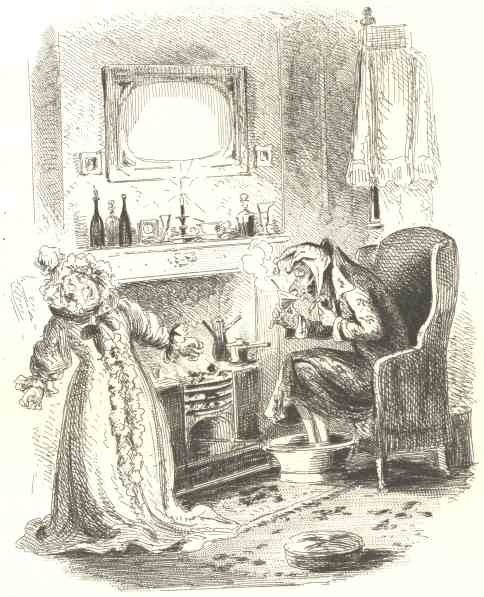
But Mr. Merrywinkle comes home to dinner. He is receivedby Mrs. Merrywinkle and Mrs. Chopper, who, on his remarking thathe thinks his feet are damp, turn pale as ashes and drag himup-stairs, imploring him to have them rubbed directly with a drycoarse towel. Rubbed they are, one by Mrs. Merrywinkle andone by Mrs. Chopper, until the friction causes Mr. Merrywinkle tomake horrible faces, and look as if he had been smelling verypowerful onions; when they desist, and the patient, provided forhis better security with thick worsted stockings and listslippers, is borne down-stairs to dinner. Now, the dinneris always a good one, the appetites of the diners being delicate,and requiring a little of what Mrs. Merrywinkle calls‘tittivation;’ the secret of which is understood tolie in good cookery and tasteful spices, and which process is sosuccessfully performed in the present instance, that both Mr. andMrs. Merrywinkle eat a remarkably good dinner, and even theafflicted Mrs. Chopper wields her knife and fork with much of thespirit and elasticity of youth. But Mr. Merrywinkle, in hisdesire to gratify his appetite, is not unmindful of his health,for he has a bottle of carbonate of soda with which to qualifyhis porter, and a little pair of scales in which to weigh itout. Neither in his anxiety to take care of his body is heunmindful of the welfare of his immortal part, as he always praysthat for what he is going to receive he may be made trulythankful; and in order that he may be as thankful as possible,eats and drinks to the utmost.
Either from eating and drinking so much, or from being thevictim of this constitutional infirmity, among others, Mr.Merrywinkle, after two or three glasses of wine, falls fastasleep; and he has scarcely closed his eyes, when Mrs.Merrywinkle and Mrs. Chopper fall asleep likewise. It is onawakening at tea-time that their most alarming symptoms prevail;for then Mr. Merrywinkle feels as if his temples were tightlybound round with the chain of the street-door, and Mrs.Merrywinkle as if she had made a hearty dinner ofhalf-hundredweights, and Mrs. Chopper as if cold water wererunning down her back, and oyster-knives with sharp points wereplunging of their own accord into her ribs. Symptoms likethese are enough to make people peevish, and no wonder that theyremain so until supper-time, doing little more than doze andcomplain, unless Mr. Merrywinkle calls out very loudly to aservant ‘to keep that draught out,’ or rushes intothe passage to flourish his fist in the countenance of thetwopenny-postman, for daring to give such a knock as he had justperformed at the door of a private gentleman with nerves.
Supper, coming after dinner, should consist of some gentleprovocative; and therefore the tittivating art is again inrequisition, and again—done honour to by Mr. and Mrs.Merrywinkle, still comforted and abetted by Mrs. Chopper. After supper, it is ten to one but the last-named old ladybecomes worse, and is led off to bed with the chronic complaintin full vigour. Mr. and Mrs. Merrywinkle, havingadministered to her a warm cordial, which is something of thestrongest, then repair to their own room, where Mr. Merrywinkle,with his legs and feet in hot water, superintends the mulling ofsome wine which he is to drink at the very moment he plunges intobed, while Mrs. Merrywinkle, in garments whose nature is unknownto and unimagined by all but married men, takes four small pillswith a spasmodic look between each, and finally comes tosomething hot and fragrant out of another little saucepan, whichserves as her composing-draught for the night.
There is another kind of couple who coddle themselves, and whodo so at a cheaper rate and on more spare diet, because they areniggardly and parsimonious; for which reason they are kind enoughto coddle their visitors too. It is unnecessary to describethem, for our readers may rest assured of the accuracy of thesegeneral principles:—that all couples who coddle themselvesare selfish and slothful,—that they charge upon every windthat blows, every rain that falls, and every vapour that hangs inthe air, the evils which arise from their own imprudence or thegloom which is engendered in their own tempers,—and thatall men and women, in couples or otherwise, who fall intoexclusive habits of self-indulgence, and forget their naturalsympathy and close connexion with everybody and everything in theworld around them, not only neglect the first duty of life, but,by a happy retributive justice, deprive themselves of its truestand best enjoyment.
p. 489THEOLD COUPLE
They are grandfather andgrandmother to a dozen grown people and have great-grandchildrenbesides; their bodies are bent, their hair is grey, their steptottering and infirm. Is this the lightsome pair whosewedding was so merry, and have the young couple indeed grown oldso soon!
It seems but yesterday—and yet what a host of cares andgriefs are crowded into the intervening time which, reckoned bythem, lengthens out into a century! How many newassociations have wreathed themselves about their hearts sincethen! The old time is gone, and a new time has come forothers—not for them. They are but the rusting linkthat feebly joins the two, and is silently loosening its hold anddropping asunder.
It seems but yesterday—and yet three of their childrenhave sunk into the grave, and the tree that shades it has grownquite old. One was an infant—they wept for him; thenext a girl, a slight young thing too delicate forearth—her loss was hard indeed to bear. The third, aman. That was the worst of all, but even that grief issoftened now.
It seems but yesterday—and yet how the gay and laughingfaces of that bright morning have changed and vanished from aboveground! Faint likenesses of some remain about them yet, butthey are very faint and scarcely to be traced. The rest areonly seen in dreams, and even they are unlike what they were, ineyes so old and dim.
One or two dresses from the bridal wardrobe are yetpreserved. They are of a quaint and antique fashion, andseldom seen except in pictures. White has turned yellow,and brighter hues have faded. Do you wonder, child? The wrinkled face was once as smooth as yours, the eyes asbright, the shrivelled skin as fair and delicate. It is thework of hands that have been dust these many years.
Where are the fairy lovers of that happy day whose annualreturn comes upon the old man and his wife, like the echo of somevillage bell which has long been silent? Let yonder peevishbachelor, racked by rheumatic pains, and quarrelling with theworld, let him answer to the question. He recollectssomething of a favourite playmate; her name was Lucy—sothey tell him. He is not sure whether she was married, orwent abroad, or died. It is a long while ago, and hedon’t remember.
Is nothing as it used to be; does no one feel, or think, oract, as in days of yore? Yes. There is an aged womanwho once lived servant with the old lady’s father, and issheltered in an alms-house not far off. She is stillattached to the family, and loves them all; she nursed thechildren in her lap, and tended in their sickness those who areno more. Her old mistress has still something of youth inher eyes; the young ladies are like what she was but not quite sohandsome, nor are the gentlemen as stately as Mr. Harvey used tobe. She has seen a great deal of trouble; her husband andher son died long ago; but she has got over that, and is happynow—quite happy.
If ever her attachment to her old protectors were disturbed byfresher cares and hopes, it has long since resumed its formercurrent. It has filled the void in the poorcreature’s heart, and replaced the love of kindred. Death has not left her alone, and this, with a roof above herhead, and a warm hearth to sit by, makes her cheerful andcontented. Does she remember the marriage ofgreat-grandmamma? Ay, that she does, as well—as if itwas only yesterday. You wouldn’t think it to look ather now, and perhaps she ought not to say so of herself, but shewas as smart a young girl then as you’d wish to see. She recollects she took a friend of hers up-stairs to see MissEmma dressed for church; her name was—ah! she forgets thename, but she remembers that she was a very pretty girl, and thatshe married not long afterwards, and lived—it has quitepassed out of her mind where she lived, but she knows she had abad husband who used her ill, and that she died in Lambethwork-house. Dear, dear, in Lambeth workhouse!
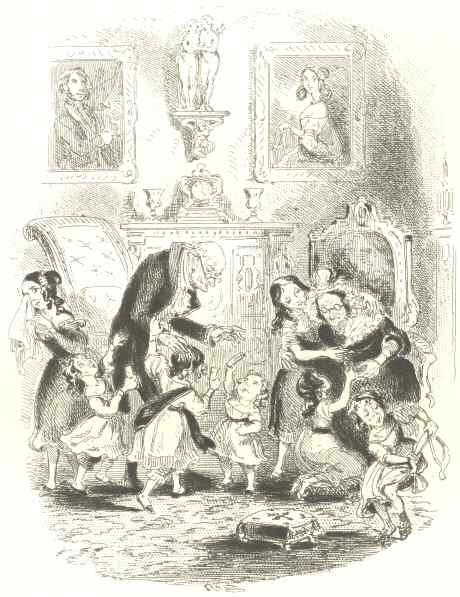
And the old couple—have they no comfort or enjoyment ofexistence? See them among their grandchildren andgreat-grandchildren; how garrulous they are, how they compare onewith another, and insist on likenesses which no one else can see;how gently the old lady lectures the girls on points of breedingand decorum, and points the moral by anecdotes of herself in heryoung days—how the old gentleman chuckles over boyish featsand roguish tricks, and tells long stories of a‘barring-out’ achieved at the school he went to:which was very wrong, he tells the boys, and never to be imitatedof course, but which he cannot help letting them know was verypleasant too—especially when he kissed the master’sniece. This last, however, is a point on which the old ladyis very tender, for she considers it a shocking and indelicatething to talk about, and always says so whenever it is mentioned,never failing to observe that he ought to be very penitent forhaving been so sinful. So the old gentleman gets nofurther, and what the schoolmaster’s niece said afterwards(which he is always going to tell) is lost to posterity.
The old gentleman is eighty years old,to-day—‘Eighty years old, Crofts, and never had aheadache,’ he tells the barber who shaves him (the barberbeing a young fellow, and very subject to that complaint). ‘That’s a great age, Crofts,’ says the oldgentleman. ‘I don’t think it’s sich awery great age, Sir,’ replied the barber. ‘Crofts,’ rejoins the old gentleman,‘you’re talking nonsense to me. Eighty not agreat age?’ ‘It’s a wery great age, Sir,for a gentleman to be as healthy and active as you are,’returns the barber; ‘but my grandfather, Sir, he wasninety-four.’ ‘You don’t mean that,Crofts?’ says the old gentleman. ‘I do indeed,Sir,’ retorts the barber, ‘and as wiggerous as JuliusCæsar, my grandfather was.’ The old gentlemanmuses a little time, and then says, ‘What did he die of,Crofts?’ ‘He died accidentally, Sir,’returns the barber; ‘he didn’t mean to do it. He always would go a running about the streets—walkingnever satisfied hisspirit—and he run against a postand died of a hurt in his chest.’ The old gentlemansays no more until the shaving is concluded, and then he givesCrofts half-a-crown to drink his health. He is a littledoubtful of the barber’s veracity afterwards, and tellingthe anecdote to the old lady, affects to make very light ofit—though to be sure (he adds) there was old Parr, and insome parts of England, ninety-five or so is a common age, quite acommon age.
This morning the old couple are cheerful but serious,recalling old times as well as they can remember them, anddwelling upon many passages in their past lives which the daybrings to mind. The old lady reads aloud, in a tremulousvoice, out of a great Bible, and the old gentleman with his handto his ear, listens with profound respect. When the book isclosed, they sit silent for a short space, and afterwards resumetheir conversation, with a reference perhaps to their deadchildren, as a subject not unsuited to that they have justleft. By degrees they are led to consider which of thosewho survive are the most like those dearly-remembered objects,and so they fall into a less solemn strain, and become cheerfulagain.
How many people in all, grandchildren, great-grandchildren,and one or two intimate friends of the family, dine togetherto-day at the eldest son’s to congratulate the old couple,and wish them many happy returns, is a calculation beyond ourpowers; but this we know, that the old couple no sooner presentthemselves, very sprucely and carefully attired, than there is aviolent shouting and rushing forward of the younger branches withall manner of presents, such as pocket-books, pencil-cases,pen-wipers, watch-papers, pin-cushions, sleeve-buckles,worked-slippers, watch-guards, and even a nutmeg-grater: thelatter article being presented by a very chubby and very littleboy, who exhibits it in great triumph as an extraordinaryvariety. The old couple’s emotion at these tokens ofremembrance occasions quite a pathetic scene, of which the chiefingredients are a vast quantity of kissing and hugging, andrepeated wipings of small eyes and noses with small squarepocket-handkerchiefs, which don’t come at all easily out ofsmall pockets. Even the peevish bachelor is moved, and hesays, as he presents the old gentleman with a queer sort ofantique ring from his own finger, that he’ll be de’edif he doesn’t think he looks younger than he did ten yearsago.
But the great time is after dinner, when the dessert and wineare on the table, which is pushed back to make plenty of room,and they are all gathered in a large circle round the fire, forit is then—the glasses being filled, and everybody ready todrink the toast—that two great-grandchildren rush out at agiven signal, and presently return, dragging in old Jane Adamsleaning upon her crutched stick, and trembling with age andpleasure. Who so popular as poor old Jane, nurse andstory-teller in ordinary to two generations; and who so happy asshe, striving to bend her stiff limbs into a curtsey, while tearsof pleasure steal down her withered cheeks!
The old couple sit side by side, and the old time seems likeyesterday indeed. Looking back upon the path they havetravelled, its dust and ashes disappear; the flowers thatwithered long ago, show brightly again upon its borders, and theygrow young once more in the youth of those about them.
p.493CONCLUSION
We have taken for the subjects ofthe foregoing moral essays, twelve samples of married couples,carefully selected from a large stock on hand, open to theinspection of all comers. These samples are intended forthe benefit of the rising generation of both sexes, and, fortheir more easy and pleasant information, have been separatelyticketed and labelled in the manner they have seen.
We have purposely excluded from consideration the couple inwhich the lady reigns paramount and supreme, holding such casesto be of a very unnatural kind, and like hideous births and othermonstrous deformities, only to be discreetly and sparinglyexhibited.
And here our self-imposed task would have ended, but that tothose young ladies and gentlemen who are yet revolving singlyround the church, awaiting the advent of that time when themysterious laws of attraction shall draw them towards it incouples, we are desirous of addressing a few last words.
Before marriage and afterwards, let them learn to centre alltheir hopes of real and lasting happiness in their own fireside;let them cherish the faith that in home, and all the Englishvirtues which the love of home engenders, lies the only truesource of domestic felicity; let them believe that round thehousehold gods, contentment and tranquillity cluster in theirgentlest and most graceful forms; and that many weary hunters ofhappiness through the noisy world, have learnt this truth toolate, and found a cheerful spirit and a quiet mind only at homeat last.
How much may depend on the education of daughters and theconduct of mothers; how much of the brightest part of our oldnational character may be perpetuated by their wisdom orfrittered away by their folly—how much of it may have beenlost already, and how much more in danger of vanishing everyday—are questions too weighty for discussion here, but welldeserving a little serious consideration from all young couplesnevertheless.
To that one young couple on whose bright destiny the thoughtsof nations are fixed, may the youth of England look, and not invain, for an example. From that one young couple, blessedand favoured as they are, may they learn that even the glare andglitter of a court, the splendour of a palace, and the pomp andglory of a throne, yield in their power of conferring happiness,to domestic worth and virtue. From that one young couplemay they learn that the crown of a great empire, costly andjewelled though it be, gives place in the estimation of a Queento the plain gold ring that links her woman’s nature tothat of tens of thousands of her humble subjects, and guards inher woman’s heart one secret store of tenderness, whoseproudest boast shall be that it knows no Royalty saveNature’s own, and no pride of birth but being the child ofheaven!
So shall the highest young couple in the land for once hearthe truth, when men throw up their caps, and cry with lovingshouts—
God blessthem.